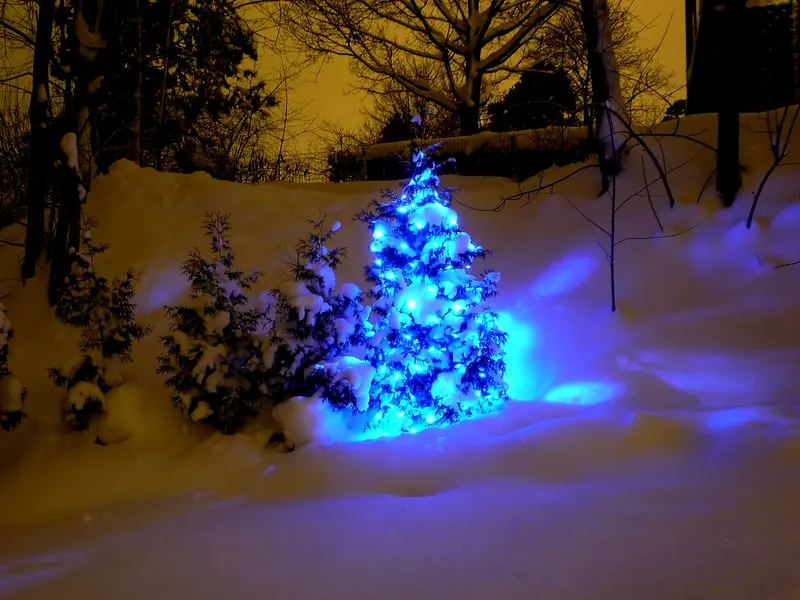
In many homes the office corner becomes part of the Christmas display: fairy lights round the window, a lit garland on the shelf, an extension lead under the desk powering both. Lights come out of the loft once a year, so they are easy to forget about until something goes wrong.
This article summarises the advice of the charity Electrical Safety First. It is general information. If you’re unsure about your home’s wiring, ask a registered electrician.
Choosing lights
Electrical Safety First says “The safest Christmas lights operate at extra-low voltage” — typically 12 to 24 volts, with a transformer that greatly reduces the risk of electric shock. Most LED sets work this way. It adds that LEDs use 80–90% less electricity than filament lamps and typically last up to 60 times longer.
Its other points when buying:
- the rated voltage should be marked on the product
- mains-powered lights need a proper UK 3-pin plug with a fuse
- buy a known brand from a reputable retailer; the charity warns that third-party sellers online may not have passed all the necessary safety checks
Checking last year’s lights
Before putting anything up, Electrical Safety First suggests you:
- check the lights are not damaged or broken, and that there are no loose wires
- check the plug and socket for burn marks, signs of arcing or heat
- replace failed lamps before use, to prevent overheating
- don’t use lights with damaged wires or plugs
Sockets, adaptors and extension leads
A home office often already runs a computer, monitor, router and chargers from one wall. Electrical Safety First’s advice is not to overload sockets and to avoid extension leads and adaptors where you can. Its website has a socket overload calculator to check what you are plugging in. Our guide to home office fire safety covers extension leads in more detail, including not plugging one lead into another.
The charity also explains that an RCD (residual current device) in your consumer unit protects against electric shocks. If you don’t have one, it suggests an RCD plug in the socket.
Lights outside
Only use lights outdoors if they are made for it. Electrical Safety First says:
- outdoor lights should be marked with a water drop symbol or an IP code, and the last digit of the IP code should be three or higher
- anything plugged in outdoors must be connected via a 30mA RCD-protected socket
- keep plugs and transformers indoors, even for outdoor-rated lights
Switching off
Its simplest piece of advice: “Switch the lights off and unplug them before you go to bed or if you go out.” That includes the lights in a home office you won’t be working in over the holidays. Teach young children not to play with the lights, and keep pets away from them.
If you’re going away for Christmas, our article on securing the house and the home office has more on leaving the house safely.
Recalls: register and check
Electrical Safety First says electrical products are recalled “more regularly than you might think”, that the response rate to a recall is often “worryingly low”, and that there are potentially millions of recalled electrical items still in UK homes. It suggests registering your lights with the maker so you can be contacted if there is a recall.
You can also search GOV.UK’s list of product safety alerts, reports and recalls, run by the Office for Product Safety and Standards, which can be filtered by product category and date.
Smoke alarms and insurance
A working smoke alarm on every floor is the backstop if anything does go wrong — see home office fire safety for the alarm rules where you live. If fire or electrical damage does happen, what your home insurance pays depends on your policy wording; our guide Home insurance and working from home explains what to check, especially for work equipment.
Alarms in our kit guide, listed with the makers’ specifications (we haven’t tested them and don’t recommend one over another):
Smoke, heat & CO alarmsRef. HW-042
FireAngel FA3820-EUX10 Carbon Monoxide Alarm
Carbon monoxide · electrochemical sensor · 10-year sealed battery
Suits: Rooms with a boiler, gas fire or wood burner
A carbon monoxide alarm with an electrochemical sensor and a sealed lithium battery for its 10-year life. Worth fitting in any room with a fuel-burning applian…
Details about FireAngel FA3820-EUX10 Carbon Monoxide Alarm Search Amazon for this — FireAngel FA3820-EUX10 Carbon Monoxide Alarm (opens Amazon.co.uk)
Smoke, heat & CO alarmsRef. HW-041
FireAngel FA6620-R Optical Smoke Alarm
Optical smoke · 10-year sealed battery
Suits: Hallways, landings and bedrooms
A battery optical smoke alarm with a sealed battery that lasts its full 10-year life, so there are no battery changes. Fit on every floor in circulation spaces…
Details about FireAngel FA6620-R Optical Smoke Alarm Search Amazon for this — FireAngel FA6620-R Optical Smoke Alarm (opens Amazon.co.uk)
Smoke, heat & CO alarmsRef. HW-043
FireAngel FA6720-R Kitchen Heat Alarm
Heat · 10-year sealed battery · BS 5446-2:2003
Suits: Kitchens, garages and utility rooms
A heat alarm for rooms where a smoke alarm would be set off by cooking fumes or steam. It sounds when the room temperature rises to between 54 and 65°C.
Details about FireAngel FA6720-R Kitchen Heat Alarm Search Amazon for this — FireAngel FA6720-R Kitchen Heat Alarm (opens Amazon.co.uk)
As an Amazon Associate we earn from qualifying purchases. Most Amazon links open a search on Amazon.co.uk, where you can see the current price, sellers and delivery. We don’t show prices, ratings or Amazon’s photos, and we haven’t tested these products.