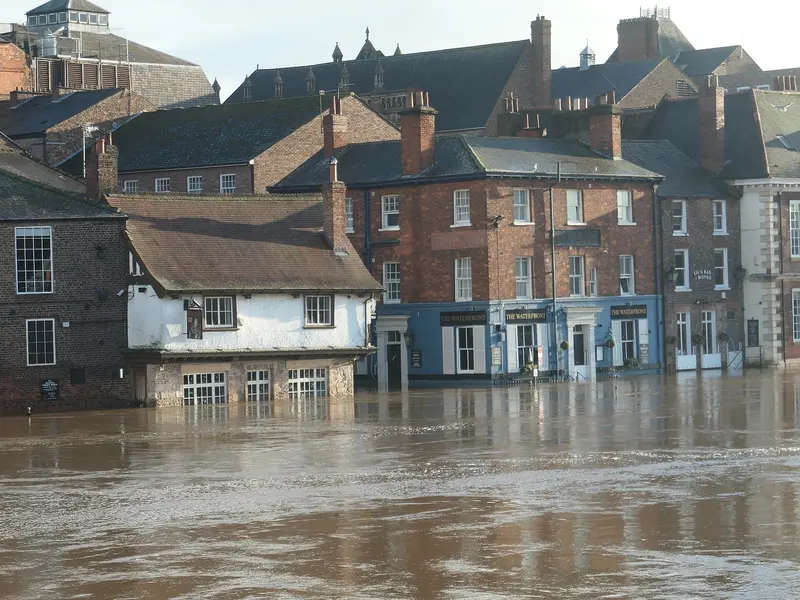
Winter storms and flooding are the kind of event most people only think about when the forecast turns. A few minutes now — signing up for warnings, knowing what your insurance says and where your important files are — makes a real difference if the water or wind arrives.
This article explains what official bodies say. It is general information, not insurance advice: what you are covered for depends on your own policy wording.
Free flood warnings
The Environment Agency runs a free flood warning service for England. GOV.UK says you can get warnings for flooding from rivers, the sea or groundwater — but not surface water (“flash”) flooding — by phone call, text or email, at any time of day or night. You can also sign up by phone through Floodline on 0345 988 1188, which is open 24 hours.
Elsewhere in the UK:
- Scotland: register with SEPA’s Floodline service
- Wales: sign up through Natural Resources Wales
- Northern Ireland: GOV.UK points to the flood maps on nidirect
GOV.UK also links to guidance on what to do before, during and after a flood.
Flood Re: what it is
Flood Re describes itself as “a re-insurance Scheme that makes flood cover more widely available and affordable” for households at the highest risk of flooding. You can’t buy from Flood Re directly: “We handle risks through insurers, we don’t work directly with householders.” It says it will run until 2039.
Flood Re’s eligibility page says homes generally qualify if they:
- have a domestic Council Tax band A to H (or equivalent)
- were built before 1 January 2009
- are used for private, residential purposes
It lists exclusions including blocks of more than three flats, company-owned houses or flats, and bed and breakfasts paying business rates. If you live in a flood-risk area and are struggling to find cover, it may be worth asking an insurer or broker whether a policy uses Flood Re.
If a storm claim is turned down
The Financial Ombudsman Service explains that when it looks at a refused storm claim, it asks three questions:
- “Do we agree that there was a storm on the date the damage happened?”
- “Is the damage consistent with what we generally see as storm damage?”
- “Were storm conditions the main cause of the damage, or did other factors mean the damage might have happened anyway?”
It says storms usually involve violent winds, often with rain, hail or snow, and that very heavy rain, hail or snow in a short time can count on its own. Weather reports and Met Office records are checked. Policies often exclude wear and tear and gradual damage, and the Ombudsman says it is for the insurer to show an exclusion applies. But a complaint is unlikely to succeed where a roof was already in poor condition, the owner knew, and the storm only showed up an existing problem.
The practical lesson: keep up with small repairs, and if a storm does cause damage, take photos and keep any weather warnings for that day.
To complain, the Ombudsman says to go to your insurer first; if you’re unhappy with the answer, or don’t get one, you can then bring it to the Ombudsman. Our guide Unhappy with an insurance claim? How to complain walks through the steps.
Protecting your work and papers
Flood water and a home office don’t mix. Keep work backed up away from the house (see the 3-2-1 backup rule), keep key documents in one place you can grab, and consider where the desk and router sit if you live in a flood-risk area. Our guide to fire-resistant safes and chests explains what fire and water ratings mean.
Fire safes & document chestsRef. HW-035
Yale Fire and Water Chest Large
30 min fire · 72 hour water protection · key lock
Sizes: 16.8 litres
Suits: A4 files and hanging folders
A key-locking insulated chest sized for A4 hanging files, for keeping paperwork safe from fire and water damage. A sensible option for household and work docum…
Details about Yale Fire and Water Chest Large Search Amazon for this — Yale Fire and Water Chest Large (opens Amazon.co.uk)
Fire safes & document chestsRef. HW-034
Yale Fire Safe Medium
NT Fire 017-60P · digital keypad lock
Sizes: 19 litres
Suits: Passports, deeds and paperwork in a home office
A fire safe with a digital keypad that Yale says protects documents from fire for 60 minutes. The 19-litre interior has adjustable shelving, and the safe can b…
Details about Yale Fire Safe Medium Search Amazon for this — Yale Fire Safe Medium (opens Amazon.co.uk)
Fire safes & document chestsRef. HW-036
Yale Fire Chest Small
Up to 30 min fire protection · key lock · B5 documents
Sizes: 4 litres
Suits: A few certificates, passports and a spare key
A compact key-locking chest with a carry handle for a small number of documents up to B5 size. Yale states up to 30 minutes of protection against heat and flam…
Details about Yale Fire Chest Small Search Amazon for this — Yale Fire Chest Small (opens Amazon.co.uk)
As an Amazon Associate we earn from qualifying purchases. Most Amazon links open a search on Amazon.co.uk, where you can see the current price, sellers and delivery. We don’t show prices, ratings or Amazon’s photos, and we haven’t tested these products.
Listed with the makers’ specifications; we haven’t tested them and don’t recommend one over another.