Working from home in winter means heating and lighting the house during the day, running a computer and screens for hours, and boiling the kettle more often than an office worker would. It adds up, and this winter several things about energy bills have changed.
This article summarises what the 28 October 2026 Budget and Ofgem, the energy regulator, say. It is general information. We don’t compare tariffs or suppliers and don’t give financial advice.
What the Budget changed
The Budget announced three measures on household energy:
- No VAT on household electricity. The Budget cut VAT on domestic electricity from 5% to 0% from 1 October 2026, and extended it “until July 2027”. Ofgem’s price cap page says there is no VAT on electricity from 1 October 2026 to 31 March 2027, while gas still carries 5% VAT. The Budget expects the extension to cut the price cap by about £50 from April 2027.
- A £100 Household Energy Payment. The Budget describes it as a £100 council tax rebate for homes in council tax bands A to D in England, starting in January 2027.
- Gas standing charges. The Budget says the government aims to abolish them by the end of 2027, or as soon as possible after.
Budget measures can change as they go through Parliament, and how a rebate reaches you depends on your council. Check GOV.UK and your council’s website rather than responding to messages that claim you must “apply” or pay a fee to get it.
How the price cap works
Ofgem’s price cap limits what suppliers can charge for each unit of energy and for the daily standing charge on standard variable tariffs. Ofgem stresses that it “does not limit the cost of your total bill”: the more you use, the more you pay. It doesn’t cover fixed deals.
The current cap runs from 1 October to 31 December 2026. Ofgem publishes the levels for each new period before it starts, so check its unit rates page for the current numbers rather than relying on older figures.
Tax relief for working from home
Some people can claim tax relief for the extra household costs of working from home, but the rules are narrower than many people think, and they changed in April 2026. Our guide to working from home tax relief explains who can claim and how, from the GOV.UK pages. If you are self-employed, GOV.UK’s simplified expenses include flat rates for working from home.
Keeping warm without wasting energy
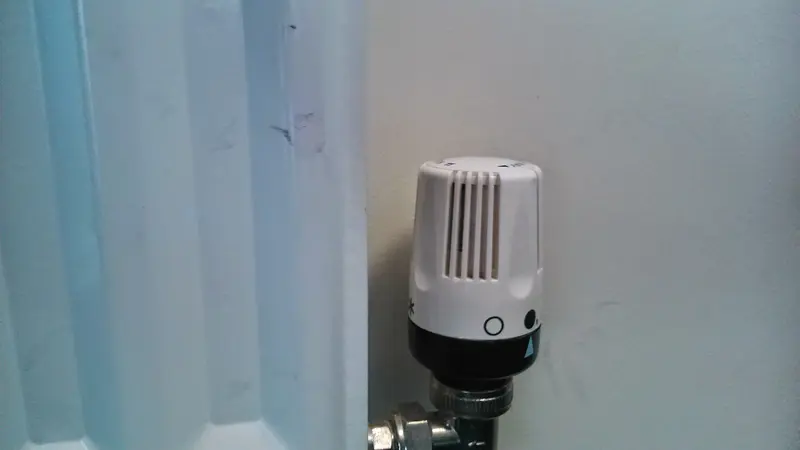
Heating one room you work in, rather than the whole house, is the obvious starting point — but don’t let the rest of the house get cold and damp. GOV.UK’s guidance on damp and mould lists, among its practical measures, making sure heating works and can be controlled, for example with thermostatic radiator valves like the one in the photo, and keeping homes ventilated. Our article on damp, condensation and mould explains why a cold, shut-up room can cause problems.
Two safety reminders for winter:
- Portable heaters and extra extension leads add fire risk. Our guide to home office fire safety covers not overloading sockets.
- If you use gas, oil or solid fuel heating, a carbon monoxide alarm matters — see carbon monoxide in winter.
If you’re struggling to pay
Ofgem’s advice is to contact your supplier. It says you can ask for a payment plan, a payment break or a reduction, ask the supplier to review your payments, and ask about hardship funds and other schemes. Ofgem also points people to government and council support, and to Citizens Advice for free advice if you are struggling to pay your bills.
If you need extra help because of age, health or disability, ask your supplier and network operator about the Priority Services Register — our article on power cuts and working from home explains it.
Power protection
A surge protector protects equipment from spikes; an uninterruptible power supply (UPS) keeps a computer running long enough to save work if the power drops. Our guide to surge protectors and UPS units explains the difference. Listed with the makers’ specifications; we haven’t tested them:
Surge protection & UPSRef. HW-014
Belkin Surge Protector with USB-C and USB-A Ports (6 Outlet)
6 sockets · 1 USB-C PD + 1 USB-A · 650 joules
Sizes: 6 sockets · 2m cord
Suits: A home-office desk with laptop, monitor and phone
A six-socket UK surge-protected extension with a USB-C PD port and a USB-A port for charging. An indicator light shows when the surge protection is still worki…
Details about Belkin Surge Protector with USB-C and USB-A Ports (6 Outlet) Search Amazon for this — Belkin Surge Protector with USB-C and USB-A Ports (6 Outlet) (opens Amazon.co.uk)
Surge protection & UPSRef. HW-018
APC Back-UPS 650VA BE650G2-UK
8 UK sockets (6 battery + 2 surge-only) · USB-A · standby
Sizes: 650VA / 400W
Suits: Riding out short power cuts on a router and PC
A small battery backup with standard UK sockets, so a router, PC or monitor keeps running through a brief power cut and you have time to save your work. Two ex…
Details about APC Back-UPS 650VA BE650G2-UK Search Amazon for this — APC Back-UPS 650VA BE650G2-UK (opens Amazon.co.uk)
Surge protection & UPSRef. HW-015
Belkin 2.4 Amp USB Charging 4-outlet Surge Protection Strip
4 sockets · 2 USB · 525 joules
Sizes: 4 sockets · 2m cord
Suits: A student desk or small home-office corner
A four-socket surge-protected strip with two USB charging ports, sized for a laptop, lamp, printer and router. It has sliding safety covers and a recessed powe…
Details about Belkin 2.4 Amp USB Charging 4-outlet Surge Protection Strip Search Amazon for this — Belkin 2.4 Amp USB Charging 4-outlet Surge Protection Strip (opens Amazon.co.uk)
As an Amazon Associate we earn from qualifying purchases. Most Amazon links open a search on Amazon.co.uk, where you can see the current price, sellers and delivery. We don’t show prices, ratings or Amazon’s photos, and we haven’t tested these products.